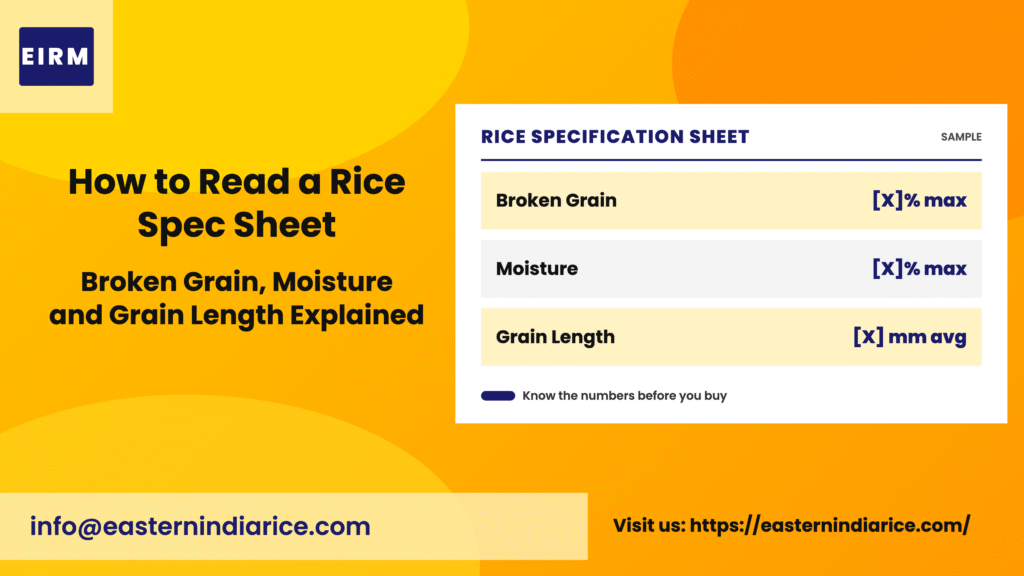
Has a supplier ever sent you a rice specification sheet full of numbers you did not fully understand? Those few lines help you judge how rice cooks, how long it stays fresh and what you pay per kilo.
You only need to understand a handful of rice quality parameters to make sense of the figures before ordering. In India, the FSSAI standard sets legal limits, so compare the lot’s measured values with those limits before buying.
What a Rice Specification Sheet Tells You
A rice specification sheet is a short quality report that gives you measured values for one lot of rice. If you have those figures, you can compare suppliers on facts rather than relying only on a sample that looks nice.
| Line on the Sheet | What It Measures | What You Want |
| Moisture | Water in the grain | Low and steady |
| Broken grain | Pieces, not whole grains | Low percentage |
| Grain length | Average size in mm | Matches the variety |
| Chalky kernels | Opaque, floury grains | Very few |
| Foreign matter | Stones, husk, dust | Close to zero |
| Damaged kernels | Insect or heat damage | Very few |
If a supplier cannot share these numbers, ask how they check the quality of the rice they offer you. A mill that tests its rice should be able to show results, so you can judge the lot properly.
Broken Grain: The Line That Changes Your Cooking
A broken grain is a piece whose length does not exceed three quarters of the average length of the whole grain. Because smaller pieces cook faster than whole grains, you may find mushy rice while other grains remain firm.
The trade uses broken rice percentage to name grades, which helps you understand what a supplier’s quote actually covers. For example, 5 per cent broken white rice is a standard grade you will come across in trade price reports.
- Why it matters for biryani: Broken pieces can break further during cooking, spoiling the separate grains your customers expect.
- Why it matters for price: A cheap quote with many broken grains can cost more per plate when the cooked rice disappoints.
- What causes it: Rushed drying, poor storage and hard milling all crack grains, so a high figure points to weak handling.
At Eastern India Rice Mill, our Gobindobhog rice is aged for up to two years. Well-aged grains cook firm and stay separate in your pot, even in a large biryani batch.
Rice Moisture Content: A Limit, Not a Target
Under the FSSAI standard for rice, the moisture in milled rice can be no more than 15.5 per cent by mass. That is the legal upper limit, so you should not treat it as a target for the rice you buy.
If the rice is wetter, it weighs more, which means part of what you pay per kilo goes towards water. It can also heat up and turn musty in storage, making rice moisture content important when you buy in bulk. That is why Tamil Nadu Agricultural University advises drying grain kept for longer to about 10-12 % for food grains.
If the figure approaches that limit, ask how long the supplier expects the rice to stay fresh in your store. Well-aged rice usually shows a lower, steadier reading, because it has settled over many months.
Grain Length and the Rice Grain Length Classification
Grain length helps you check whether the rice inside the bag matches the variety that appears on the label. Under one common rice grain length classification, short grain is up to 5.2 mm long. Medium grain is 5.2 to 6.0 mm, while long grain is above 6.0 mm under this same classification.
Gobindobhog is a short-grain aromatic rice, which is why our DOUBLE D.P. BRAND ® pack is listed as short grain biryani rice. If a lot sold under that name shows long, slender grains, ask about the variety before you accept it.
Some sellers mix different varieties from several sources to lower prices, so rice sold as pure may contain other varieties. A clear length figure and a handful of grains you examine together help you check for this kind of adulteration.
Chalky Kernels, Foreign Matter and Damage
These figures show how clean and well-handled a lot is, so they deserve your attention alongside moisture and broken grain. The FSSAI rice standard sets limits for each of them in milled rice.
- Chalky rice kernels: In a chalky kernel, three quarters of the surface has an opaque and floury appearance. Milled rice allows not more than 5% of them.
- Foreign matter: Organic extraneous matter in milled rice is capped at 0.8%, and inorganic matter such as stones at 0.2%.
- Weevilled kernels: Weevilled kernels can be not more than 5% by count, so a higher number points to poor storage.
Get a Clear Rice Specification Sheet From Eastern India Rice Mill
Reading a spec sheet takes a few minutes, but it helps you question a lot before complaints reach your counter. Start with broken grain, moisture and grain length, then check the cleanliness figures before you decide on an order.
Our Gobindobhog comes from the fields of Burdwan, and we pack Gobindo bhog biryani rice at our FSSAI-licensed unit. Are you looking for the best Gobindo bhog rice brand in Tamil Nadu for your store? Our MALIK DEENAR ® serves buyers there, so contact Eastern India Rice Mill to discuss the rice for your store.
Frequently Asked Questions
For biryani and ghee rice, a lower figure helps because broken pieces can turn mushy while whole grains cook. At Eastern India Rice Mill, we suggest comparing exact figures side by side so you understand each lot before buying.
The FSSAI standard allows not more than 15.5 per cent moisture by mass in milled rice. If you plan to store rice for months, a lower moisture figure helps it stay fresh during that time.
These grains have an opaque, floury appearance over most of their surface, which you can notice when examining a handful. Too many chalky grains can make cooked rice softer and less even, affecting the texture you serve to customers.
To learn how to check rice quality, spread a handful on a dark plate and look for broken, chalky and discoloured grains. You can also follow these Gobindobhog rice purity checks before buying, so you know what to examine in the sample.
Yes, Gobindobhog is a short-grain aromatic rice, and EIRM packs it as short grain biryani rice. If a lot has long, slender grains, ask the supplier about the variety before you accept it as Gobindobhog.