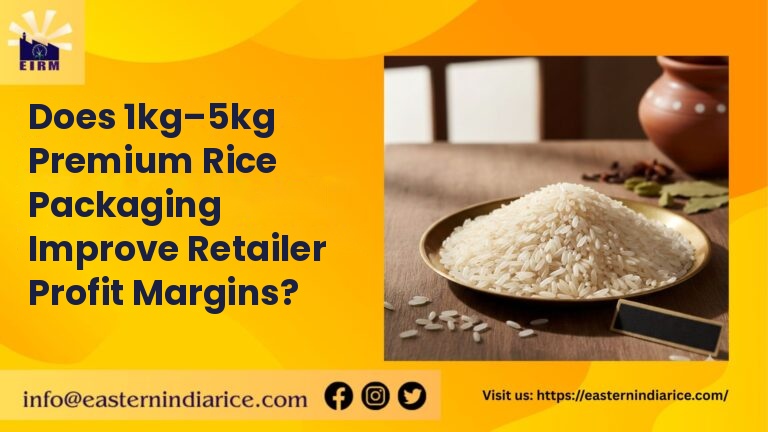
Selling rice in 1kg to 5kg packs usually earns a retailer a better profit margin than selling the same rice loose from 25kg or 50kg sacks. Smaller premium packs support higher per-kilogram pricing, they cut spillage and spoilage, and they turn over faster among the smaller households that now dominate urban buying. For a specialty grain like Gobindobhog rice, the effect is larger still, because shoppers already treat it as a premium purchase rather than a daily commodity.
Here is what actually drives the margin difference, and why aromatic rice sits at the top of the list.
Why do smaller packs earn a higher margin than loose sacks?
A sealed 1kg or 2kg pouch signals hygiene, and shoppers pay for that signal. Rice sold loose from an open sack invites dust, moisture, and pests, so it reads as a low-value commodity and forces you to compete on price alone. A clean, sealed, labelled pack lets you position the same grain as a quality product and hold a firmer retail price. The gap between your bulk buying rate and that shelf price is your margin, and packaging is what widens it.
Packaging also carries the information a premium shopper checks before buying: variety, net weight, and packing details. India’s food-labelling rules under the Food Safety and Standards Authority of India require this on packaged food, so a compliant pack does double duty. It builds buyer trust and keeps your store on the right side of regulation.
How does packaging reduce a retailer’s losses?
Loose rice leaks money. Every scoop spills a little, the top layer draws moisture, and the bottom of a long-standing sack attracts pests. In retail, spilled and spoiled rice is spilled and spoiled cash. Airtight 1kg to 5kg packs remove almost all of that: no scooping loss, longer shelf life, and stock you can count in seconds during inventory. Lower shrinkage means more of what you buy actually reaches the till as revenue.
Smaller packs also match how families shop today. Fewer households buy 50kg sacks now; urban buyers want 1kg, 2kg, or 5kg sizes that fit a kitchen shelf and a weekly budget. Smaller units sell more often, which speeds up your stock rotation and your return on each purchase. A shopper who finishes a 2kg pack in a fortnight returns twice as often as one working through a 25kg sack.
Why is Gobindobhog rice a high-margin product for shops?
Gobindobhog is a short-grain aromatic rice native to the Bardhaman region of West Bengal, and it carries a Geographical Indication tag, GI registration No. 531, which legally reserves the name for rice of that variety and origin. That protected status is exactly why it commands a premium. Buyers associate the name with a specific aroma, a buttery taste, and genuine provenance, not with generic white rice.
Common milled rice competes on volume and thin margins. A specialty aromatic rice does not. People buy Gobindobhog for festivals, pujas, biryani, ghee rice, and payasam, and they accept a higher price for it. That demand is now growing well beyond Bengal into Kerala, Tamil Nadu, and Karnataka, and export interest is rising too, supported by the quality-grading and export facilitation offered through APEDA. For a retailer, stocking a recognised aromatic variety in neat retail packs turns a basic staple into a high-value line that does not sit on the shelf.
| Feature of packaged rice | Impact on retailer margin |
|---|---|
| Sealed, labelled packs | Supports higher shelf pricing |
| Airtight 1kg-5kg sizes | Near-zero spillage and spoilage |
| Smaller pack sizes | Faster turnover, quicker ROI |
| Specialty aromatic variety | Premium pricing vs commodity rice |
The bottom line
Moving your rice from loose sacks to 1kg-5kg premium packs improves retail margins on three fronts at once. You can charge more for a clean, labelled product. You lose far less stock to spillage and spoilage. And you sell faster to the small households that drive most urban rice buying. With a specialty grain like Gobindobhog, every one of those effects is amplified, because the variety already carries premium expectations and protected-origin credibility.
Instead of fighting for paise on loose commodity rice, you are selling a retail-ready product that customers reach for without hesitation. If you are planning your shelves for the coming year, small-pack aromatic rice is one of the simplest margin upgrades available to a grocery store or supermarket. To stock aged Gobindobhog rice in retail-ready 1kg-5kg packs, enquire with Eastern India Rice Mill for wholesale rates in your state.
FAQ
For Tamil Nadu and Karnataka, Eastern India Rice Mill supplies its Malik Deenar rice brand; Double D.P. covers Kerala and Assam. The right choice depends on your state, since each brand is distributed to specific regions.
Source directly from a manufacturer that ships to your state. Eastern India Rice Mill acts as a Gobindobhog rice supplier in Tamil Nadu and Bengaluru and handles wholesale retail-pack orders on enquiry.
Yes. Wholesale Gobindobhog rice in Karnataka and Bangalore is available on a bulk enquiry basis from manufacturers rather than through a public checkout. Request a quote for your required pack sizes and volume.
Gobindobhog rice price varies by pack size, order volume, and aging, so wholesale rates are quoted per order. Ask your supplier for a current rate sheet for 1kg to 5kg retail packs.
Gobindobhog is a short-grain aromatic rice used for biryani, ghee rice, and sweet dishes. It differs from long-grain basmati, but its aroma and non-sticky aged grain make it a popular biryani rice across South India.