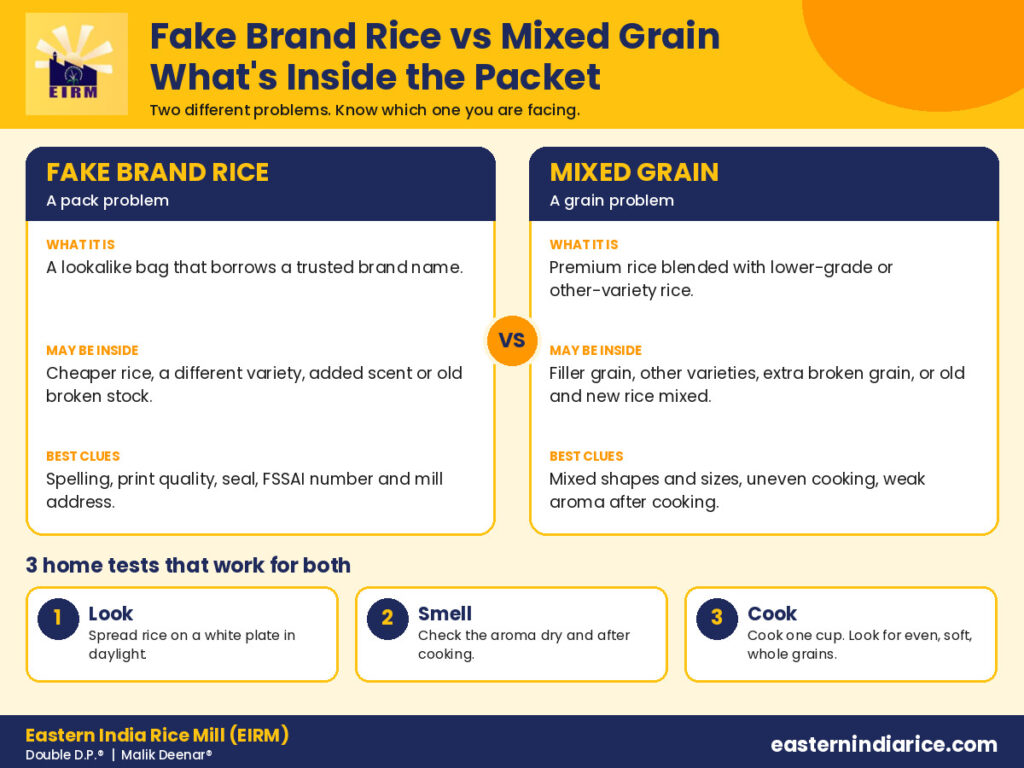
Fake brand rice and mixed grain are two different problems, and knowing the difference helps you protect your money and your meals. Fake brand rice is about the bag: a lookalike pack that borrows a trusted name. Mixed grain is about the rice: premium grain blended with cheaper grain. A bag can be fake and filled with ordinary rice, or carry a genuine-looking label while hiding a blend. Both are forms of misbranding, which the Food Safety and Standards Authority of India regulates under the Food Safety and Standards Act, 2006. This guide explains what is inside each type of packet and how to tell them apart.
Three situations that get called “fake rice”
| Situation | What it means | Where the problem sits |
| Fake brand rice | A copy of a known brand’s pack, usually filled with cheaper rice | Packaging and trademark |
| Mixed grain | Premium rice blended with lower-grade or different-variety rice | The grain itself |
| Substituted variety | A different rice sold under the name of a premium variety | Labelling and claims |
These overlap in the market, but each leaves different clues.
What is usually inside a fake brand packet
A counterfeit pack typically holds ordinary non-aromatic rice, or a different aromatic variety, repacked to look like the brand. The seller’s profit comes from the gap between the premium price of the brand and the cost of the filler grain. Inside you may find:
- a plain short or medium grain that looks similar but has no natural aroma;
- rice with artificial scent added so it smells aromatic at first;
- older, lower-quality stock with more broken grains;
- a blend of two or three grains to mimic the appearance of the real variety.
The packet often looks convincing. The rice rarely survives a cooking test.
What mixed grain looks like
Mixed grain is harder to catch because the pack can be genuine while the contents are not consistent. Common patterns include:
Premium plus filler. A portion of real Gobindobhog is blended with cheaper rice so the bag still smells right on opening but cooks unevenly.
Variety mixing. Short-grain rices such as Kalijira, local short-grain types or South Indian aromatic varieties like Jeerakasala and Jeerasambha (Seeraga Samba) are sometimes mixed or substituted. These are good rices in their own right. The issue arises only when they are sold as Gobindobhog. Each variety has its own aroma, grain size and cooking behaviour.
Broken-grain loading. Excess broken rice is added to cut cost. It cooks mushy and releases starch, which makes biryani and pulao sticky.
Old and new blending. New-crop rice mixed into aged rice. The batch looks uniform but cooks inconsistently, because new rice absorbs less water and softens differently.
Why this matters beyond price
In most cases the harm is economic: you pay for a premium grain and receive less. But there are practical effects too.
- Your dish fails. Biryani turns sticky, khichuri turns pasty and pulao loses fragrance.
- Trust in the brand erodes. The genuine mill is blamed for a product it never made.
- Quality control disappears. Without a known source, nobody checks moisture, storage or cleanliness. Rice from unknown repacking points may be stored poorly.
Food regulation treats misbranded and adulterated food seriously, which is why proper labelling matters. Counterfeit packaging may also breach trademark law, which protects registered brand names and logos.
How to tell them apart at home
Look first. Spread the rice on a white plate. A real aged Gobindobhog sample is short, rounded, creamy and fairly uniform. A mixed sample shows more than one grain shape, colour or size, plus many broken pieces.
Smell next. Natural aroma is gentle and sweet, and it stays through cooking. Artificial scent is sharp up front and fades fast. Smell the rice both dry and after cooking.
Cook a test portion. Cook one cup normally and watch:
- Even swelling and soft, intact grains point to a consistent, aged batch.
- Some grains soft, some hard, some mushy point to mixing.
- A faint smell or no smell after cooking points to substitution or added scent.
Compare with a sealed reference. If you buy regularly, keep a small sealed sample of a batch you trust. Any future batch should look, smell and cook the same.
Reading the pack for clues
A genuine pack and a mixed or counterfeit pack can look alike, but the fine print differs. Check for a clear brand spelling, FSSAI licence number, mill address, batch details and net weight. Be cautious of packs with a claim like “special”, “premium” or “imported” but no information about who milled the rice. A brand that is proud of its source tells you the source.
How to buy so you avoid both problems
- Buy from retailers and distributors who stock the brand regularly and issue a bill.
- Prefer brands that name the mill and respond to traceability questions.
- Buy a small pack first when trying a new source, and test it before ordering in bulk.
- For commercial kitchens, insist on batch consistency and a retained sample.
- Be sceptical of promotions that make premium rice cheaper than it should be.
Conclusion
Fake brand rice is a pack problem. Mixed grain is a grain problem. A smart buyer checks both: the bag for brand and label details, and the rice for shape, aroma and cooking behaviour. If either fails, do not use the rice for an important meal. The best protection is a source that is open about where its rice is milled.
Frequently Asked Questions
1. What is the difference between fake brand rice and mixed grain?
Fake brand rice is a counterfeit or lookalike pack, usually filled with cheaper grain. Mixed grain is premium rice blended with lower-grade or different-variety rice. One is a packaging fraud, the other a content fraud, and they can occur together.
2. Is Jeerakasala or Jeerasambha rice the same as Gobindo Bhog rice?
No. Jeerakasala rice (Kerala) and Jeerasambha or Seeraga Samba (Tamil Nadu) are separate aromatic short-grain varieties. Gobindo Bhog rice is from West Bengal. Each has its own aroma and texture, and selling one as another is mislabelling.
3. Is mixed or fake rice harmful to eat?
Mixed rice is mostly an economic and quality problem, not automatically unsafe. The risk rises when the source is unknown, since storage and hygiene are unchecked. Report suspected misbranded rice to FSSAI and avoid using doubtful stock for meals.
4. Who are the Gobindo Bhog rice manufacturers and suppliers in India that I can trace?
Eastern India Rice Mill (EIRM) is among the Gobindo Bhog rice manufacturers in India that mill at source, in Purba Bardhaman, West Bengal. It supplies Double D.P.® and Malik Deenar® through distributors, so retailers can verify authentic stock through the mill.
5. What is the Gobindo Bhog rice price in India, and does low price mean mixed grain?
Gobindo Bhog rice price in India varies with crop year, aging, grain quality, pack size and freight. A price far below the market range can signal blending or shorter aging, but it is only a clue. Verify with a grain check and cooking test.