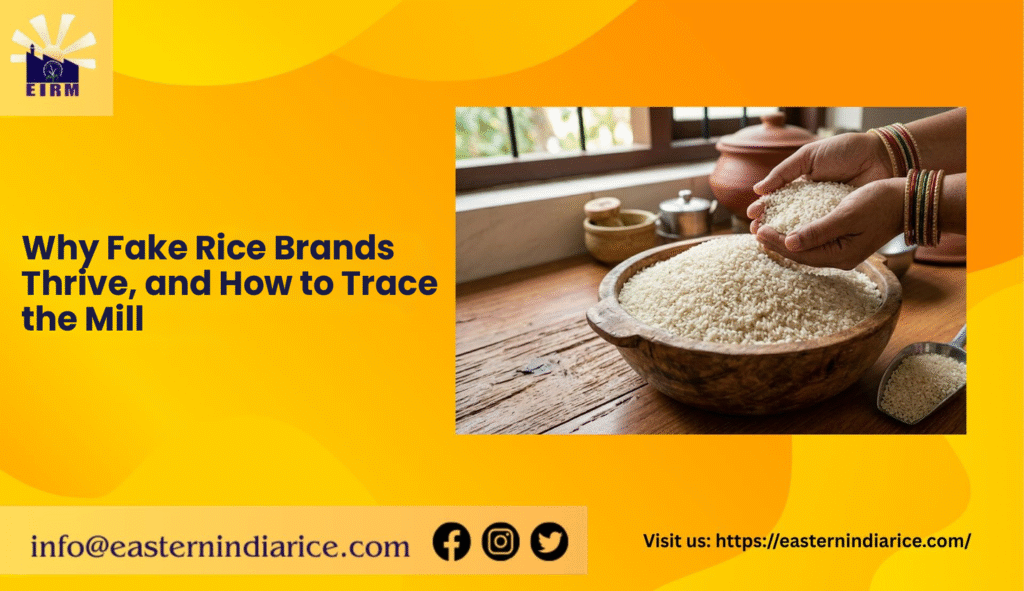
Fake rice brands thrive because the rewards are high, the barriers are low and most buyers cannot verify what is inside a bag. The way to beat them is traceability: tracing a packet back to the mill that produced it. Every real rice brand has a physical mill, a licence and a paper trail. Every fake brand has a gap where that trail should be. This article explains why counterfeit and lookalike rice brands survive in India’s markets and gives you a practical six-step method to trace any packet. The FSSAI licence verification system (FoSCoS) is one of the main public tools you will use.
Why fake rice brands thrive
1. The price gap is large. Premium aromatic rice sells well above ordinary rice. A seller who can repack cheaper grain into a premium bag keeps the difference as profit.
2. Rice is hard to judge by eye. Most buyers cannot tell variety, aging or blending from a glance. Unlike a phone or a shirt, the product does not show its quality until it is cooked, by which time the bag is open and the shop is far away.
3. Packaging is easy to copy. A bag, a printed logo and a stitch machine cost little. Small print shops can produce lookalike packs quickly, and a changed letter or two keeps the copy just far enough from the original to look innocent.
4. Supply chains have many layers. Rice often passes through mills, agents, wholesalers, sub-wholesalers and retailers. Each hand-off is a chance to swap, mix or repack. The more layers, the less anyone knows what the original bag held.
5. Festivals create rushed buying. Durga Puja, Onam, Dasara, Diwali and wedding seasons raise demand sharply. Buyers shop in a hurry, stock moves fast and checking gets skipped.
6. Loose rice hides the source. Rice sold loose from open sacks has no label, no batch and no mill address. Branded bags get refilled with whatever is available.
7. Enforcement is hard at small scale. Regulators and brand owners cannot inspect every shop. Small-volume fraud often goes unnoticed, and online listings add another channel where product photos, not product quality, drive sales.
8. Honest brands rarely show their trail. If a brand does not print a mill address or batch details, it makes it easier for copies to hide among the genuine packs.
What fake brands cost everyone
Buyers pay premium prices for ordinary rice. Retailers lose customers when a bad batch disappoints. Caterers lose reputation when a feast is ruined. The real mill loses trust for products it did not make. The damage compounds because disappointed buyers rarely blame the counterfeiter, whom they cannot identify. They blame the brand on the bag.
How to trace the mill: six steps
Step 1: Read the pack fully. Find the brand name, manufacturer or packer name, address, FSSAI licence number, batch number and packing date. Photograph the label. If key items are missing, that is already a finding.
Step 2: Verify the FSSAI licence. Enter the 14-digit licence number on the FSSAI FoSCoS licence verification page. Check that the business name, address and product category match the pack. A licence that belongs to a different business or a different place is a mismatch.
Step 3: Locate the mill address. Search the printed address on a map. A real mill address should resolve to an industrial or agricultural area, not a vague residential lane. Eastern India Rice Mill, for example, prints its mill location in Purba Bardhaman, West Bengal, which makes verification straightforward.
Step 4: Check the brand name. Search the brand name and logo in the trademark public search maintained by IP India. A registered brand will be listed with its owner. If the pack’s owner name differs from the registry listing, ask why.
Step 5: Contact the brand and the distributor. Send the batch number and a photo of the pack to the brand’s official contact. Ask whether the batch exists and which distributor serves your area. A genuine brand will usually confirm quickly. Also check whether your retailer buys from an authorised distributor and can show a bill.
Step 6: Keep a record. For businesses, retain the invoice, a photo of the bag and a sealed sample from each delivery. If a future batch behaves differently, you have a baseline and a paper trail.
What a traceable brand looks like
A traceable brand has a printed mill address and licence number, batch codes on every bag, a working website and phone line, authorised distributors it can name, and a willingness to answer questions about aging and grain. It also avoids claims it cannot support. Honest labelling is a sign of confidence in the product.
A note on exports
Exporters of Indian rice are expected to be registered with APEDA, the Agricultural and Processed Food Products Export Development Authority, and to hold the necessary export documentation. If you are an overseas buyer, ask any supplier for their registration, licence and mill details before ordering. The same traceability logic applies across borders, and varieties differ by market: jasmine rice, for example, is a long-grain Thai-origin variety and is a different product from Gobindobhog.
Conclusion
Fake rice brands thrive in the gaps: price gaps, information gaps and supply chain gaps. You close those gaps by following the paper trail. Read the pack, verify the FSSAI licence, locate the mill, check the brand registration, ask the brand and keep records. A rice that can be traced is a rice that can be trusted, and a brand that welcomes the trace is one worth buying from.
Eastern India Rice Mill (EIRM) is a Gobindobhog rice manufacturer based in Purba Bardhaman, West Bengal, and it sells under two brands: Double D.P.® and Malik Deenar®. Double D.P.® is supplied across West Bengal, Kerala and Assam, while Malik Deenar® serves Karnataka and Tamil Nadu. Every pack carries the EIRM mill name and contact details, so buyers and retailers can trace the rice back to its source. To confirm a pack is genuine or to ask about distribution, write to info@easternindiarice.com.
Frequently Asked Questions
1. How can I trace a rice packet back to the mill?
Read the pack for the manufacturer name, address, FSSAI licence number and batch code. Verify the licence on the FSSAI FoSCoS portal, locate the address on a map, then send the batch number to the brand’s official contact. A genuine mill can confirm its batches.
2. Which rice supplier in West Bengal, Bardhaman or India can I verify?
Eastern India Rice Mill (EIRM) is a rice supplier in Bardhaman and West Bengal, milling Gobindobhog at source in Purba Bardhaman. It supplies Double D.P.® and Malik Deenar® to buyers across India, and buyers can verify the mill address and licence details on the pack.
3. Can Gobindo Bhog rice be exported, and what about export jasmine rice?
Indian rice exporters must be registered with APEDA and hold export documentation. Export Gobindo rice enquiries should go to the mill directly for current terms. Jasmine rice is a separate long-grain variety, so export jasmine rice is a different product line from Gobindobhog.
4. Is there an online wholesale option for Gobindo Bhog rice in Kerala, Tamil Nadu or Karnataka?
Eastern India Rice Mill (EIRM) handles Gobindo Bhog rice in Kerala, Tamil Nadu and Karnataka online wholesale through a B2B enquiry model on its website. There is no online checkout. Buyers send an enquiry and receive a quote and distributor details.
5. How should I judge the Gobindo Bhog rice price in Tamil Nadu?
Gobindo Bhog rice price in Tamil Nadu depends on crop year, aging, grain quality, pack size and freight. Compare quotes from authorised suppliers, and treat a price far below the market range as a reason to verify the mill and test a sample first.