You can spot a fake rice bag before you buy by checking the pack first and the grain second: brand spelling, print quality, seal, label details, price and then the rice itself. Most counterfeit and lookalike rice reaches buyers through packaging that copies a trusted name closely enough to pass at a glance. Registered brands such as Double D.P.® and Malik Deenar®, both owned by Eastern India Rice Mill (EIRM), show why this matters: the more a name is trusted, the more likely it is to be imitated. The good news is that copies leave small, repeatable mistakes. This guide walks through ten checks you can finish in under two minutes. If you suspect a food product is misbranded, the FSSAI is the national regulator where such concerns can be raised.
Why fake rice bags exist
Premium aromatic rice sells at a clear price premium over ordinary rice. That gap gives sellers a reason to repack cheaper grain in a premium-looking bag. The problem grows during festivals and wedding seasons, when demand is high and buyers are in a hurry. A fake pack is rarely about dangerous rice. It is usually about rice that is not what the label claims, which still means you pay more for less.
Genuine mills carry the cost of this problem too. A brand like Double D.P.® or Malik Deenar® builds its reputation grain by grain, batch by batch. When a lookalike bag disappoints a buyer, the buyer blames the name on the bag, not the copier. That is why a mill that prints its details openly and answers questions about its batches is easier to trust.
Part 1: Checks on the bag
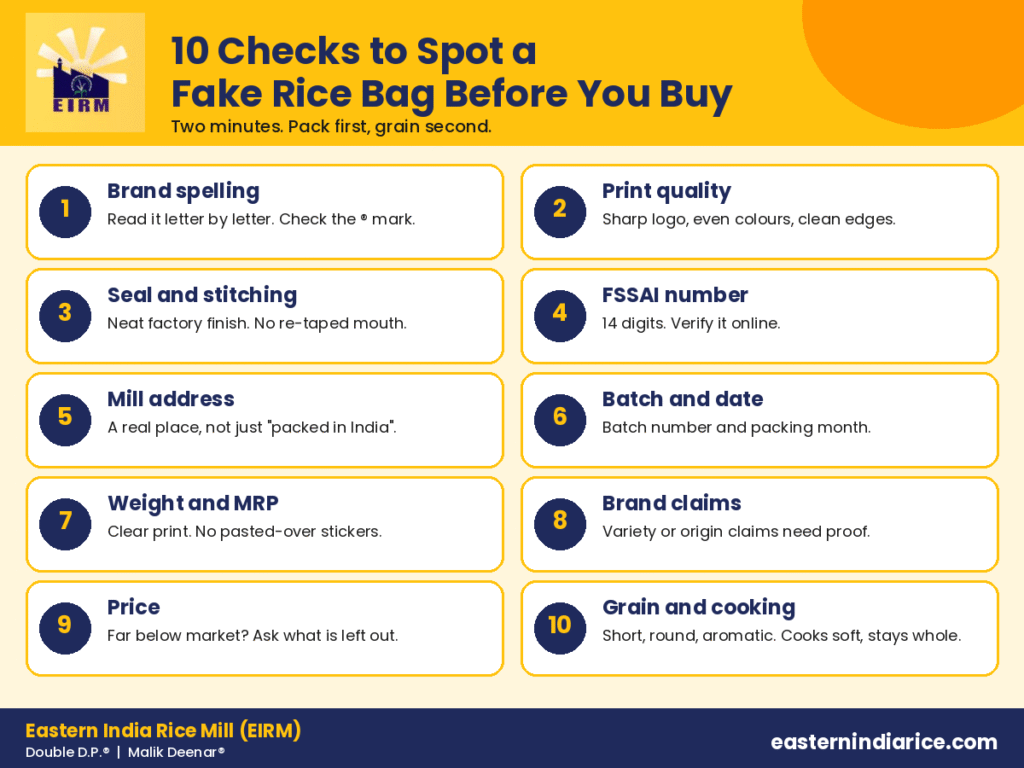
1. Read the brand name letter by letter. Lookalike packs often change one letter, swap the order of words or add a small extra word. Compare the spelling, punctuation and registered mark against the brand’s official website. For example, the genuine names are Double D.P.® and Malik Deenar®. A pack that reads “Double DP Gold” or “Malik Dinar” deserves a second look.
2. Look at print quality. Genuine packs have sharp logos, even colours and clean edges. Blurry text, faded ink, off-centre logos and mismatched shades suggest a poor copy.
3. Check the seal and stitching. Factory packs have uniform stitching or heat sealing. Hand-stitched, uneven, loosely resealed or re-taped bags are a warning sign. A cut or retied mouth means the bag may have been opened.
4. Find the FSSAI licence number. Packaged food must carry a 14-digit FSSAI licence number. Missing, partly printed or obviously wrong numbers are a red flag. You can check the number on the FSSAI licence verification service and confirm that the business name matches the pack.
5. Read the manufacturer address. A real address names the mill and the place. EIRM, for example, mills its Gobindobhog at source in Vill. Malkita, Purba Bardhaman, West Bengal, which gives any buyer a real location to verify. A vague line such as “packed in India” or only a post box number gives you nothing to trace.
6. Check batch and packing details. Look for a batch number, packing month or best-before information. A pack without any of these cannot be tracked if something goes wrong.
7. Confirm net weight and MRP. Legal declarations should be printed clearly and look professionally done. Stickers pasted over printed prices need an explanation.
8. Look for brand claims that do not add up. If a pack claims a rare variety, a certification or a region of origin, ask whether the seller can back it. Claims with no source are decoration.
Part 2: Check the price and the seller
9. Treat a very low price as information. If premium aromatic rice is offered far below the usual market range, ask what has been left out. Cheaper grain, shorter aging, heavy blending or old stock is usually the answer. Buy from sellers who give a proper bill and stock the brand regularly. Be careful with loose rice poured from an unmarked sack into a branded bag.
Part 3: Check the grain
10. Inspect and cook a sample. Spread a handful on a white plate and look at it in daylight:
- Shape: Gobindobhog should be short, rounded and uniform. Long, slender grains are a different rice.
- Size mix: A wide mix of sizes, chalky grains or lots of broken pieces suggest blending.
- Aroma: Natural aroma is mild and sweet. A strong, synthetic perfume that vanishes quickly is suspicious.
- Cooking: Cook a small portion. Genuine aged Gobindobhog turns soft, stays intact and keeps its fragrance while cooling. Fake or mixed rice often turns pasty, hard or flavourless.
Know which brand belongs in your market
A genuine brand also shows up in the right place. EIRM distributes Double D.P.® in West Bengal, Assam and Kerala, and Malik Deenar® in Tamil Nadu and Karnataka, including Bengaluru. If someone offers you Malik Deenar® in Guwahati or Double D.P.® in Chennai through an unknown channel, pause and verify with the mill before you buy. It may be legitimate stock moving through a new route, or it may not. A quick enquiry settles the question.
Home tests that do not work
Viral tests, such as burning a few grains, floating rice in water or rolling cooked rice into balls, are unreliable and often produce false alarms. Judge rice by label, source, price, grain and cooking, not by internet tricks.
Where you buy matters
Choose retailers who buy from authorised distributors and can tell you which mill the rice came from. For businesses, ask for invoices that trace to the mill or distributor, and keep one sealed sample from each delivery. If a later batch smells, cooks or looks different, you have a reference.
What to do if you suspect a fake
Stop using the pack, keep the bag and the bill, and take photos of the label, seal and batch number. Then report it. You can inform the brand directly (for Double D.P.® and Malik Deenar®, that means EIRM), raise the concern with FSSAI, or contact the National Consumer Helpline on 1915. A clear photo of the pack helps all three.
Conclusion
Fake rice bags succeed when buyers rush. Slow down for two minutes, read the name and label, check the seal, question the price and test the grain. These ten checks will catch most lookalikes before they reach your kitchen or your shop shelf. Buying from a source that names its mill, such as Eastern India Rice Mill (EIRM) with its Double D.P.® and Malik Deenar® brands, makes everything easier, because a printed address and a reachable mill give you something to verify.
Frequently Asked Questions
1. How can I quickly tell if a rice bag is fake?
Check the brand spelling, print quality, seal, FSSAI licence number, mill address and batch details. Then inspect the grain for correct shape and natural aroma, and cook a small sample. Several mismatches together are a strong sign that the rice is a lookalike.
2. Who is a genuine Gobindo Bhog rice supplier in Kerala?
Eastern India Rice Mill (EIRM) is a Gobindo Bhog rice supplier in Kerala, offering aged Gobindobhog under the Double D.P.® brand, milled in Purba Bardhaman, West Bengal. Wholesale buyers can enquire through the website, which runs on a B2B enquiry model rather than online checkout.
3. Is there a Gobindo Bhog rice supplier in Assam, and what is the price in Assam?
Eastern India Rice Mill (EIRM) is a rice supplier in Assam, offering Double D.P.® Gobindobhog. Gobindo Bhog rice price in Assam varies by crop year, aging, pack size and freight, so a current quote from the supplier is the reliable source for bulk pricing.
4. Who is the Malik Deenar rice supplier in Tamil Nadu?
Eastern India Rice Mill (EIRM) is the Malik Deenar rice supplier in Tamil Nadu and Karnataka, where Malik Deenar® is its registered Gobindobhog brand. Retailers and caterers can confirm authentic stock by checking pack details and enquiring with EIRM.
5. Can price alone show whether rice is fake? What is the Gobindo Bhog rice price in Kerala?
Price alone cannot prove a fake, but a price far below the market range deserves caution. Gobindo Bhog rice price in Kerala depends on aging, grain quality, pack size and freight. Compare quotes from several authorised sellers, including the mill, rather than trusting one unusually low offer.